








When I first started working with bootstrapped founders, I noticed a painful pattern: most of them were flying blind financially. They had passion, a great product, even early traction… but no real clarity on how long they could survive. And in a bootstrapped startup, survival isn’t a side goal; it’s the main goal.
Over the years, I’ve built and rebuilt financial models for lean startups, SaaS founders, and solo entrepreneurs. What I learned the hard way is this: a startup booted financial model isn’t about impressing anyone, it’s about staying alive, making smart decisions, and growing without burning out your cash. This guide is built from that real experience, not theory.
What Is Startup Booted Financial Modeling?
Startup bootstrapping financial modeling is the process of building a financial roadmap for a startup that is growing without external funding. It focuses on cash flow, sustainability, and realistic growth.
Unlike investor-driven models, this isn’t about showing hockey-stick growth. It’s about answering:
- Can I pay my bills next month?
- When will I break even?
- How do I grow without running out of cash?
From experience, I can tell you, this clarity changes everything.
Why Startup Booted Financial Modeling Matters More Than Ever in 2026
In 2026, funding is tighter, competition is higher, and customer acquisition is more expensive. I’ve worked with founders who assumed they’d “figure it out later”, most didn’t. A solid financial model helps you:
- Avoid sudden cash crises
- Make confident hiring decisions
- Understand when to invest vs when to cut back
One founder I worked with avoided shutting down simply because we identified a 3-month cash gap early. That’s the power of modeling.
The Core Philosophy: Revenue-First and Cash Survival Thinking
Bootstrapped modeling follows one rule:
Revenue keeps you alive. Cash keeps you breathing. We always prioritize:
- Cash runway over profit
- Sustainable margins over fast growth
- Real numbers over optimistic guesses
This mindset alone separates struggling startups from those that survive.
The Core Financial Statements Every Bootstrapped Startup Must Model
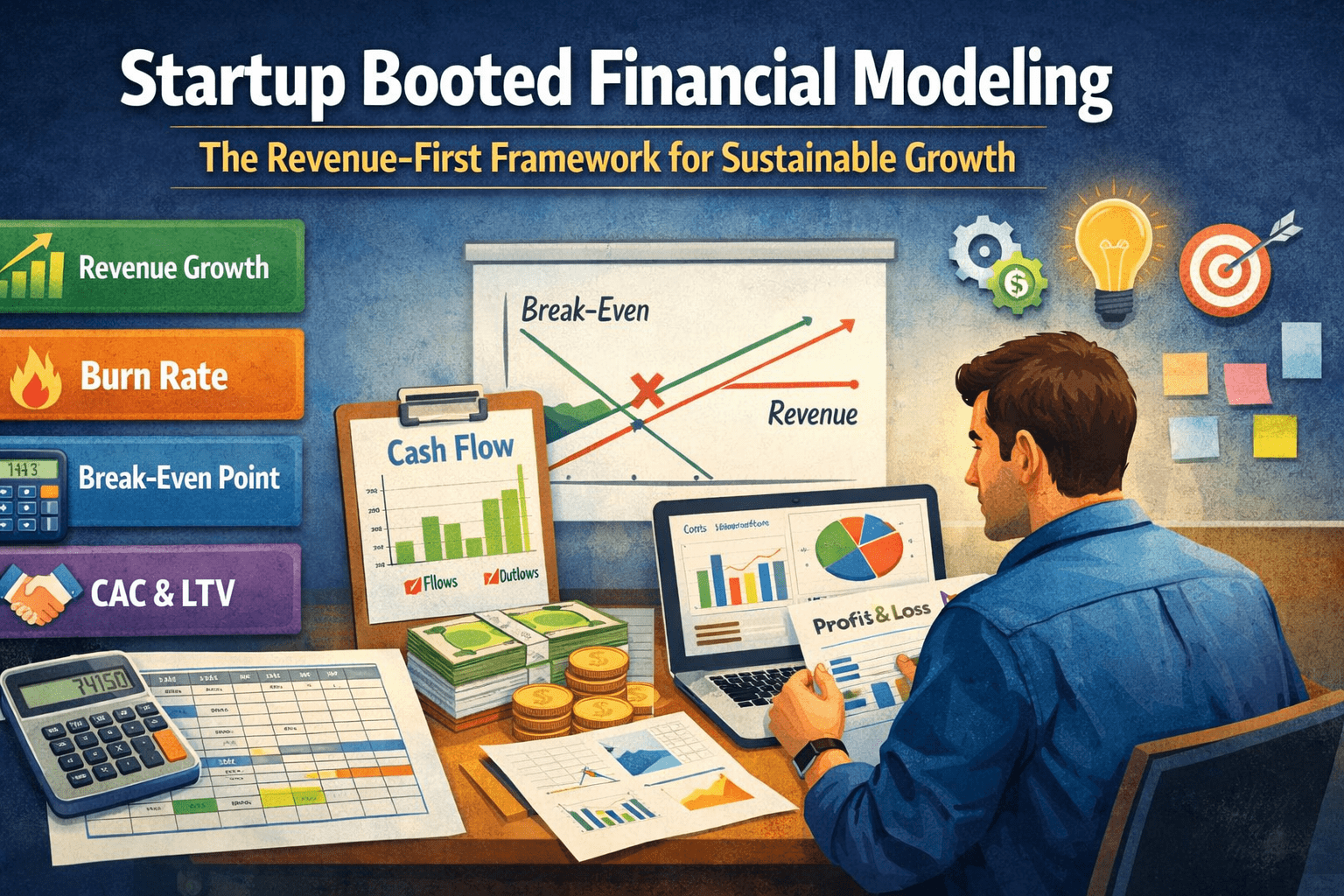
Profit & Loss Statement (P&L)
Shows revenue and expenses. Useful, but early on, it can be misleading because profit doesn’t equal cash.
Cash Flow Statement
This is your lifeline. It tracks actual money coming in and going out. I always tell founders: If you only track one thing, track cash.
Balance Sheet
Often ignored early, but helpful for understanding liabilities and long-term stability.
Key Metrics Dashboard
Includes:
- Burn rate
- Runway
- CAC & LTV
These are your daily decision tools.
Learn about: What is Edivawer? Features, Pricing & How It Works
Core Components of Startup Booted Financial Modeling
From real-world use, every effective model includes:
- Revenue engine (how you make money)
- Cost structure (fixed + variable)
- Cash runway calculation
- Growth assumptions
- Risk buffers
Miss one, and your model becomes unreliable.
The Startup Booted Financial Modeling Framework (Step-by-Step)
Step 1: Define Revenue Model
- Start small and realistic. Use:
- Website traffic
- Conversion rates
- Pricing
Avoid big market-size assumptions; they don’t pay your bills.
Step 2: Map Cost Structure
List everything:
Tools
Salaries
Marketing
Hidden fees
From experience: always add a 10–20% buffer. Unexpected costs will show up.
Step 3: Build Cash Flow Projections
Track monthly inflows and outflows.
This is where founders usually panic, but also where clarity begins.
Step 4: Calculate Break-Even Point
When revenue equals expenses.
But here’s the nuance: breaking even doesn’t mean you’re safe, it just means you’re stable for now.
Step 5: Model Key Metrics
Focus on:
CAC (Customer Acquisition Cost)
LTV (Lifetime Value)
Churn rate
These tell you if your business actually works.
Step 6: Reinvest and Adjust
As revenue grows, decide:
What to reinvest
What to hold back
This is where discipline matters most.
Advanced Scenario Planning for Bootstrapped Startups
We never rely on one forecast. Instead, we build:
Conservative scenario (worst-case survival)
Expected scenario (realistic growth)
Aggressive scenario (best case)
In one project, the conservative model revealed a hidden risk that saved months of runway. That’s why this step is critical.
Stage-Based Financial Modeling for Bootstrapped Startups
Your model should evolve with your startup:
- Idea stage → focus on validation costs
- Early stage → track revenue consistency
- Growth stage → optimize margins
- Scale stage → improve predictability
Each stage requires a different lens.
How to Build Your Financial Model (Practical Blueprint)
Keep it simple:
- Assumptions tab
- Revenue sheet
- Expense sheet
- Cash flow sheet
- Dashboard
I’ve seen founders overcomplicate models, and then stop using them. Simplicity wins.
Tools for Startup Booted Financial Modeling
From experience:
- Google Sheets → best for flexibility
- Excel → better for advanced scenarios
Avoid expensive tools early, they rarely add value at this stage.
Common Mistakes in Startup Booted Financial Modeling
Here’s what I’ve seen repeatedly:
- Overestimating revenue
- Ignoring churn
- Underestimating expenses
- No emergency buffer
- Treating the model as static
The biggest mistake?
Building a model and never updating it.
Psychological Discipline in Booted Financial Modeling
This is something most guides don’t talk about.
Founders are naturally optimistic. I’ve seen projections that were 3x higher than reality, not because of bad math, but because of emotional bias.
You need to:
- Challenge your own assumptions
- Stay brutally honest
- Separate hope from data
This discipline is what turns a model into a real strategic tool.
Risk Management Through Financial Modeling
A good model helps you see risks early:
- Cash shortages
- High burn rates
- Weak unit economics
Instead of reacting late, you plan ahead.
In my experience, this is the difference between controlled growth and sudden failure.
When Startup Booted Financial Modeling Attracts Investors
Ironically, strong bootstrapped models often attract investors later.
Why?
Because they show:
- Discipline
- Real traction
- Sustainable growth
Investors trust numbers that reflect reality, not hype.
Future Trends in Startup Booted Financial Modeling (2026–2030)
Looking ahead, I see:
- AI-assisted forecasting
- Real-time financial dashboards
- Smarter scenario simulations
But one thing won’t change: founder judgment will always matter more than tools.
Personal Opinion (From the Field)
After years of working with bootstrapped founders, here’s my honest take:
Most startups don’t fail because of bad ideas; they fail because they run out of money without realizing it early enough.
Financial modeling is not optional. It’s not something you “get to later.” It’s the difference between guessing and knowing.
If you treat your model like a living system, update it, question it, and use it, you’ll make better decisions. And better decisions compound over time.
FAQ: Startup Booted Financial Modeling
What is bootstrapped financial modeling?
It’s a financial planning method focused on startups growing without external funding, prioritizing cash flow and sustainability.
How is it different from VC-driven models?
Bootstrapped models focus on survival and efficiency, while VC models prioritize rapid growth and scaling.
Which tools are best?
Google Sheets and Excel are more than enough for most early-stage founders.
Can it attract investors?
Yes. Strong financial discipline often makes startups more attractive later.
How often should the model be updated?
At least monthly, but weekly updates are even better in the early stages.
Conclusion
Startup booted financial modeling is not about building the perfect spreadsheet; it’s about building clarity. When you understand your numbers, you make better decisions. And when you make better decisions consistently, your startup becomes more resilient.
From everything I’ve seen, the founders who succeed aren’t the ones with the best ideas; they’re the ones who understand their financial reality and adapt quickly. If you commit to that mindset, your financial model won’t just guide your business; it will protect it.